The Sensor That Never Burns Out — Built for Every Job
Infrared Sensor: 10-Year Field Life
LeakHawk Pro's infrared sensor works optically with no chemical burnout. Rated for 10 years, far outlasting standard heated diode detectors.
Universal Refrigerant Coverage
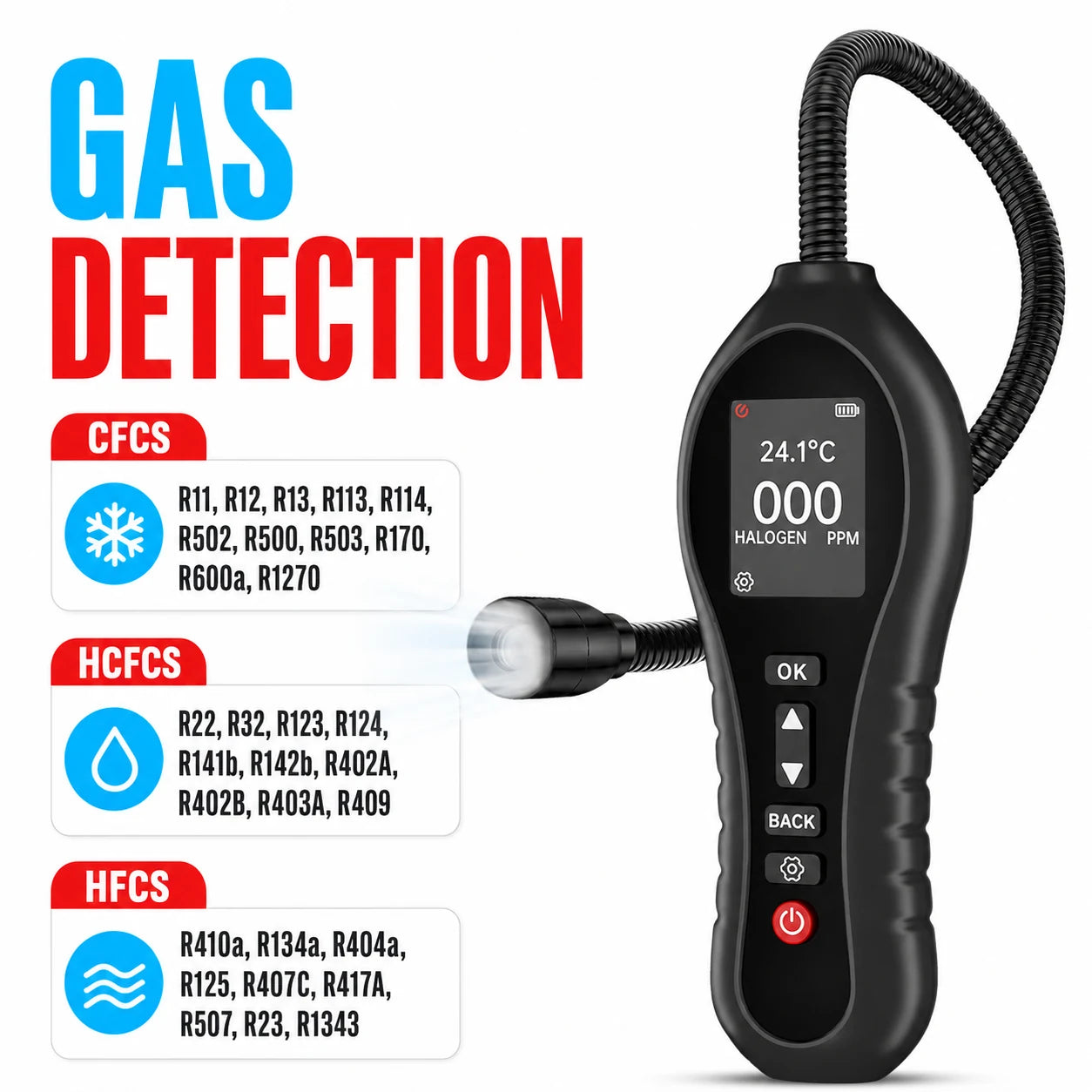
LeakHawk Pro identifies R22, R32, R1234yf, and all major A2L blends in one tool. No need to upgrade as the industry shifts to low-GWP refrigerants.
Progressive Proximity Alerts
LeakHawk Pro beeps faster and the LCD intensifies as you zero in on a leak. Infrared recovery takes seconds after a big hit, not minutes.
Reach Tight Spaces Without Disassembly
The bendable 9.44-inch probe reaches behind coils and into tight bays. Glove-friendly controls mean no removing gloves mid-job.
What our 17,000+ Customers say
Based On Real and Honest Experiences
Frequently Asked Questions
How precise is the LeakHawk Pro at detecting leaks?
Very. LeakHawk Pro's infrared sensor detects refrigerant down to 1 PPM — equivalent to 0.03 oz per year, matching top pro models. That catches slow leaks that raise energy bills 15-30% before they're obvious.
Which refrigerant types does it support?
It covers the full spectrum of halogenated refrigerants — R11, R22, R134a, R404a, R417A, plus all CFC, HCFC, HFC, and refrigerant blend variants commonly found in today's systems.
How long does the sensor last — is it really 10 years?
Yes. LeakHawk Pro's infrared sensor is rated for roughly 10 years versus 100-300 hours for heated diode models. It works optically, never burning out from refrigerant exposure — no $80-150 tip kits needed.
Will it trigger false alarms from soap, oil, or moisture?
Rarely. Soap, moisture, and oil that cause false alarms in heated diode sensors don't absorb infrared light the way refrigerant does. LeakHawk Pro distinguishes real refrigerant from job-site contaminants, so every alert is reliable.
Can it reach inside tight or enclosed equipment spaces?
Absolutely. The flexible 9.44-inch probe bends to navigate cramped enclosures, behind panels, and into corners where rigid detectors simply cannot go — no disassembly needed.
Can a regular homeowner use this, or do you need EPA certification?
Any homeowner can use LeakHawk Pro — no EPA certification is required to detect leaks. EPA 608 is only needed to handle bulk refrigerant, not to diagnose where a system is losing it.
What's the difference between infrared and heated diode detectors?
Heated diode sensors degrade chemically as refrigerant burns on a hot tip, causing false alarms or failure over time. LeakHawk Pro measures how much refrigerant blocks an infrared beam — no chemical reaction, no burnout, far longer life.
Will it find leaks that my current detector or technician missed?
Very likely. Small leaks of 0.03-0.25 oz per year go undetected when a heated diode sensor is degraded. LeakHawk Pro's infrared sensor stays calibrated over time, catching what worn detectors miss.